what determines the vibrational state that an electron decays to
Fluorescence simply occurs later on a chemical species has showtime been excited past electromagnetic radiation. The emission of radiation by a solid object heated in a flame (due east.g., a slice of iron) is not fluorescence considering the excitation has occurred thermally rather than through the absorption of electromagnetic radiation. Fluorescence can occur from species that have been excited past UV/VIS radiation. To consider what happens in the process of fluorescence, we demand to think of the possible free energy states for a ground and excited state organisation.
Draw an energy level diagram for a typical organic chemical compound with \(\pi\) and \(\pi\) * orbitals.
Figure \(\PageIndex{1}\) represents the energy levels for a typical organic compound in which the \(\pi\) orbitals are full and the \(\pi\)* orbitals are empty.
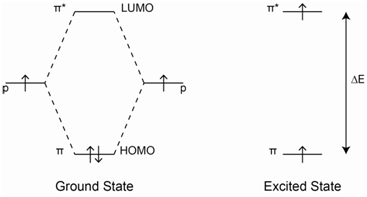
Figure \(\PageIndex{1}\). Free energy level diagram for \(\pi\)- and \(\pi\)*-orbitals of a typical organic compound.
Now consider the electron spin possibilities for the ground and excited country. Are there dissimilar possible ways to orient the spins (if so, these correspond different spin states).
The basis state, which is shown on the left in Figure \(\PageIndex{1}\), has two electrons in the \(\pi\)-orbital. These 2 electrons must have contrary spins or else they would have the same four quantum numbers. Therefore, there is simply ane possible style to align the spins of the 2 electrons in the \(\pi\)-orbital.
The excited state has 1 electron in the \(\pi\)-orbital and one electron in the \(\pi\)*-orbital equally shown in Effigy \(\PageIndex{i}\). In this instance, there are two possible ways we might marshal the spins. In i case, the electron in the \(\pi\)*-orbital could have the contrary spin of the electron in the \(\pi\)-orbital (due east.g., the electrons accept paired spins, even though they are in dissimilar orbitals – encounter Figure \(\PageIndex{2}\), middle diagram). In the other instance, the electron in the \(\pi\)*-orbital could have a spin that is parallel with the electron in the \(\pi\)-orbital (see Effigy \(\PageIndex{2}\) – far right diagram). In both cases, information technology does not matter which electron has spin-up and which has spin-down, the but important point is that in i case the two spins are opposite and in the other they are parallel. The free energy level diagram in Figure \(\PageIndex{two}\) shows representations for the two possibilities.
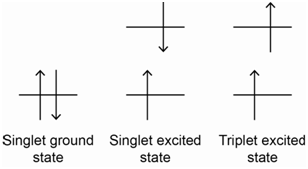
Figure \(\PageIndex{ii}\). Representations of possible spin states for footing and excited state systems.
Practise you call up these different spin states have different energies?
Since they are different from each other (i.east., spins parallel versus spins paired), it makes sense that they would have different energies.
Which one practice you lot look to be lower in energy?
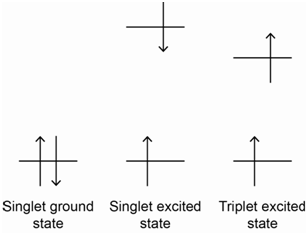
To answer this question, we have to think back to a rule we established with placing electrons into atomic or molecular orbitals that have the aforementioned energy (i.e., are degenerate). We learned that electrons go into degenerate orbitals with parallel spins and only pair up their spins when forced to exercise so (e.one thousand., an atomic piii configuration has three unpaired electrons with parallel spins; just when nosotros added a 4th electron to make a pfour configuration do two of the electrons have paired spins). The rationale we gave for this observation is that configurations with parallel spins in degenerate orbitals are lower in energy than configurations with paired spins (i.eastward., it took energy to pair up electron spins). Applying this general concept to the state of affairs in a higher place, we can reason that the configuration in which the electrons in the \(\pi\)- and \(\pi\)*-orbitals have parallel spins is lower in free energy than the configuration in which the two electrons accept paired spins. The free energy level diagrams in Figure \(\PageIndex{3}\) show the lower energy of the configuration where the electrons have parallel spins.
If the spin state is defined as (2S + 1) where Due south represents the total electronic spin for the system, try to come up with names for the footing and possible excited states for the arrangement that are based on their spin state.
Call back that spin quantum numbers are either +½ or –½. S, the total electronic spin for the system, is the sum of the individual spin quantum numbers for all of the electrons.
In the example of the basis state, for every electron with a spin of +½ at that place is an electron with a spin of –½. Therefore, the value of South is zippo. The spin land, which is 2S + 1, would have a value of one.
In the instance of the excited country in which the electrons have paired spins (+½ and –½), the value of Southward is too nada. Therefore, the spin land, which is 2S + 1, would have a value of 1.
In the example of the excited country in which the electrons have parallel spins (+½ and +½; past convention, we employ the positive value of the spin for parallel spins when determining the spin state), the value of S is now one. Therefore, the spin country, which is 2S + 1, would have a value of 3.
The name we utilize to signify a organisation with a spin state of one is a singlet state. The name nosotros use to signify a system with a spin state of three is a triplet land. Note that the ground state is a singlet state and that 1 of the excited states is a singlet land besides. We differentiate these by denoting the energy level with a number subscript. And so the ground singlet state is denoted every bit S0 whereas the get-go excited state is denoted as S1. It is possible to excite a molecular species to higher electronic states so that higher energy Sii, Siii, etc. singlet states be also. The triplet state would be denoted as Tone. There are also Ttwo, T3, etc. likewise. Now we can depict a more than complex energy diagram for the molecule that shows different singlet and triplet levels (Figure \(\PageIndex{4}\)).
Draw a diagram of the energy levels for such a molecule. Describe arrows for the possible transitions that could occur for the molecule.
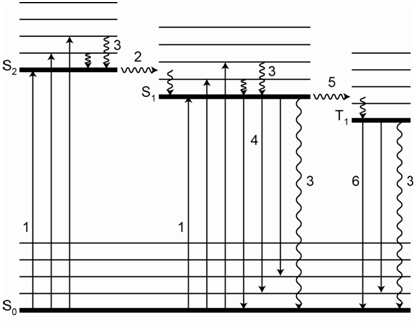
Figure \(\PageIndex{4}\). Free energy level diagram for a molecular species.
Note in Figure \(\PageIndex{four}\) how a triplet country is slightly lower in free energy than the corresponding singlet state. Annotation besides that there are vibrational and rotational levels superimposed within the electronic states as we observed earlier when considering UV/VIS spectroscopy. The energy level diagram in Figure \(\PageIndex{4}\) shows the transitions that can occur inside this manifold of free energy states for an organic molecule. The transitions are numbered to facilitate our discussion of them.
Transition ane (Absorption)
The transitions labeled with the number (1) in Figure \(\PageIndex{4}\) represent the procedure of absorption of incident radiations that promotes the molecule to an excited electronic state. The diagram shows the absorption process to the Southi and Sii states. It is as well possible to excite the molecule to college vibrational and rotational levels within the excited electronic states, so there are many possible absorption transitions. The post-obit are equations that evidence the absorption of dissimilar frequencies of radiation needed to excite the molecule to S1 and Sii.
\[\mathrm{S_0 + h\nu = S_1}\]
\[\mathrm{S_0 + h\nu ' = S_2}\]
Information technology is reasonable at first to recollect that there is an absorption transition that goes directly from the S0 to the T1 state. This is a transition that involves a spin-flip and it turns out that transitions that involve a spin-flip or modify in spin land are forbidden, meaning that they exercise not happen (although, as we will before long encounter, sometimes transitions that are forbidden practise happen). What is important here is that yous will not get direct excitation from the S0 level to a higher energy triplet country. These transitions are truly forbidden and practise non happen.
Transition ii (Internal Conversion)
Internal conversion is the process in which an electron crosses over to another electronic state of the aforementioned spin multiplicity (e.g., singlet-to-singlet, triplet-to-triplet). The internal conversion in Figure \(\PageIndex{4}\) is from S2 to Sone and involves a crossover into a college free energy vibrational state of Sane. Information technology is likewise possible to have internal conversion from Si to a higher vibrational level of Southward0.
Transition 3 (Radiationless decay – loss of free energy every bit heat)
The transitions labeled with the number (iii) in Figure \(\PageIndex{4}\) are known as radiationless decay or external conversion. These by and large stand for to the loss of free energy as heat to surrounding solvent or other solute molecules.
\[\mathrm{S_1 = S_0 + rut}\]
\[\mathrm{T_1 = S_0 + oestrus}\]
Note that systems in S1 and T1 can lose their extra energy as heat. Likewise, systems excited to higher energy vibrational and rotational states also lose their actress free energy equally oestrus. The energy diagram level in Figure \(\PageIndex{4}\) shows systems excited to higher vibrational levels of S1 and all of these will rapidly lose some of the extra energy as estrus and drop downwards to the Southwardone level that is simply electronically excited.
An of import consideration that effects the various processes that take place for excited state systems is the lifetimes of the different excited states. The lifetime of a detail excited state (e.k. the S1 state) depends to some degree of the specific molecular species being considered and the orbitals involved, but measurements of excited land lifetimes for many different compounds allows us to provide ballpark numbers of the lifetimes of different excited states.
The lifetime of an electron in an S2 state is typically on the order of 10-15 second.
The lifetime of an electron in an S1 state depends on the energy levels involved. For a \(\pi\)-\(\pi\)* organization, the lifetimes range from 10-7 to 10-nine second. For a n-\(\pi\)* organisation, the lifetimes range from 10-five to 10-7 second. Since \(\pi\)-\(\pi\)* molecules are more commonly studied by fluorescence spectroscopy, Due southi lifetimes are typically on the club of 10-8 second. While this is a small number on an absolute scale of numbers, note that it is a large number compared to the lifetimes of the S2 state.
The lifetime of a vibrational state is typically on the order of 10-12 second. Note that the lifetime of an electron in the Due south1 country is significantly longer than the lifetime of an electron in a vibrationally excited land of South1. That means that systems excited to vibrationally excited states of Sane chop-chop lose oestrus (in ten-12 second) until reaching Due south1, where they then "intermission" for 10-8 2d.
Transition four (Fluorescence)
The transition labeled (iv) in Figure \(\PageIndex{four}\) denotes the loss of energy from Southward1 as radiation. This process is known as fluorescence.
\[\mathrm{S_1 = S_0 + h\nu}\]
Therefore, molecular fluorescence is a term used to describe a singlet-to-singlet transition in a system where the chemical species was first excited by absorption of electromagnetic radiation. Annotation that the diagram in Figure \(\PageIndex{4}\) does not evidence molecular fluorescence occurring from the S2 level. Fluorescence from the Southward2 state is extremely rare in molecules and there are merely a few known systems where it occurs. Instead, what happens is that near molecules excited to energy states higher than S1 quickly (10-15 second) undergo an internal conversion to a high energy vibrational state of Due south1. They and then chop-chop lose the extra vibrational energy as rut and "pause" in the S1 country. From South1, they can either undergo fluorescence or undergo some other internal conversion to a high energy vibrational state of Southward0 and so lose the energy as estrus. The extent to which fluorescence or loss of estrus occurs from Due south1 depends on particular features of the molecule and solution that we will discuss in more detail afterward in this unit.
An important aspect of fluorescence from the Due southone state is that the molecule can stop up in vibrationally excited states of South0, as shown in the diagram above. Therefore, fluorescence emission from an excited state molecule can occur at a variety of dissimilar wavelengths. Just similar nosotros talked nigh with absorbance and the probability of dissimilar transitions (reflected in the magnitude of the molar absorptivity), fluorescent transitions accept dissimilar probabilities as well. In some molecules, the S1-to-South0 fluorescent transition is the most probable, whereas in other molecules the most probable fluorescent transition may involve a higher vibrational level of Si. A molecule ending up in a higher vibrational level of S1 after a fluorescent emission will quickly lose the actress energy as heat and drop down to S0.
So how practice fluorescent low-cal bulbs work? Inside the tube that makes upwards the bulb is a gas comprised of argon and a small amount of mercury. An electrical electric current that flows through the gas excites the mercury atoms causing them to emit light. This calorie-free is not fluorescence because the gaseous species was excited by an electric current rather than radiations. The light emitted past the mercury strikes the white powdery blanket on the inside of the drinking glass tube and excites information technology. This coating and then emits light. Since the blanket was excited by light and emits low-cal, it is a fluorescence emission.
Transition v (Intersystem crossing)
The transition labeled (5) in Effigy \(\PageIndex{4}\) is referred to as intersystem crossing. Intersystem crossing involves a spin-flip of the excited state electron. Remember that the electron has "paused" in Sane for almost ten-viii 2nd. While at that place, information technology is possible for the species to interact with things in the matrix (e.1000. collide with a solvent molecule) that can crusade the electron in the basis and/or excited country to flip its spin. If the spin flip occurs, the molecule is now in a vibrationally excited level of T1 and information technology quickly loses the actress vibrational free energy as rut to drop downwardly to the T1 electronic level.
What practice you look for the lifetime of an electron in the T1 land?
Earlier we had mentioned that transitions that involve a modify in spin state are forbidden. Theoretically that means that an electron in the T1 state ought to be trapped in that location, because the only identify for it to go on losing free energy is to the Southward0 state. The effect of this is that electrons in the T1 country have a long lifetime, which tin can be on the order of 10-4 to 100 seconds.
There are ii possible routes for an electron in the Tone state. One is that another spin flip tin can occur for one of the two electrons causing the spins to be paired. If this happens, the system is at present in a high-free energy vibrational state of South0 and the extra energy is lost rapidly as radiationless decay (transition 3) or heat to the environs.
Transition 6 (Phosphorescence)
The other possibility that can occur for a system in Tone is to emit a photon of radiation. Although, theoretically a forbidden procedure, it does happen for some molecules. This emission, which is labeled (six) in Figure \(\PageIndex{four}\), is known equally phosphorescence. There are two mutual occasions where you lot take likely seen phosphorescence emission. One is from glow-in-the-dark stickers. The other is if you have e'er turned off your television in a nighttime room and observed that the screen has a glow that takes a few seconds to die down. Phosphorescence is usually a weak emission from well-nigh substances.
Why is phosphorescence emission weak in most substances?
One reason why phosphorescence is usually weak is that it requires intersystem crossing and population of the Ti state. In many compounds, radiationless decay and/or fluorescence from the Southone state is preferable to intersystem crossing and not many of the species ever make it to the Tane state. Systems that happen to have a close match between the energy of the S1 land and a higher vibrational level of the T1 state may have relatively high rates of intersystem crossing. Compounds with non-bonding electrons often have college degrees of intersystem crossing because the energy deviation between the Sone and T1 states in these molecules is less. Paramagnetic substances such as oxygen gas (O2) promote intersystem crossing because the magnetic dipole of the unpaired electrons of oxygen can interact with the magnetic spin dipole of the electrons in the species nether study, although the paramagnetism too diminishes phosphorescence from Ti besides. Heavy atoms such as Br and I in a molecule likewise tend to promote intersystem crossing.
A second reason why phosphorescence is often weak has to do with the long lifetime of the T1 state. The longer the species is in the excited state, the more collisions it has with surrounding molecules. Collisions tend to promote the loss of excess energy equally radiationless decay. Such collisions are said to quench fluorescence or phosphorescence. Appreciable levels of phosphorescent emission volition require that collisions in the sample be reduced to a minimum. Hence, phosphorescence is usually measured on solid substances. Glow-in-the-nighttime stickers are a solid material. Chemic substances dissolved in solution are normally cooled to the signal that the sample is frozen into a solid glass to reduce collisions before recording the phosphorescence spectrum. This requires a solvent that freezes to a articulate glass, something that tin can be difficult to achieve with h2o every bit it tends to expand and fissure when frozen.
Which transition (\(\pi\) *- \(\pi\) or \(\pi\) *-n) would have a college fluorescent intensity? Justify your reply.
There are two reasons why you would expect the \(\pi\)*-n transition to accept a lower fluorescent intensity. The outset is that the molar absorptivity of due north-\(\pi\)* transitions is less than that of \(\pi\)-\(\pi\)* transitions. Fewer molecules are excited for the n-\(\pi\)* instance, and then fewer are available to fluoresce. The 2nd is that the excited land lifetime of the due north-\(\pi\)* state (10-five-10-7 second) is longer than that of the \(\pi\)-\(\pi\)* country (10-7-10-9 second). The longer lifetime means that more than collisions and more collisional deactivation will occur for the n-\(\pi\)* system than the \(\pi\)-\(\pi\)* system.
Now that we sympathise the transitions that tin can occur in a system to produce fluorescence and phosphorescence occurs, we can examine the instrumental setup of a fluorescence spectrophotometer.
Source: https://chem.libretexts.org/Bookshelves/Analytical_Chemistry/Book%3A_Molecular_and_Atomic_Spectroscopy_(Wenzel)/3%3A_Molecular_Luminescence/3.2%3A_Energy_States_and_Transitions
0 Response to "what determines the vibrational state that an electron decays to"
Publicar un comentario